PnP Core SDK - ASP.NET Core Sample
This solution demonstrates how the PnP Core SDK can be used in a ASP.NET Core web application
Source code
You can find the sample source code here: /samples/Demo.ASPNetCore
Prerequisites
- .NET 10.0 SDK or higher installed. You can download it from https://dotnet.microsoft.com/download
Additional prerequisites for Visual Studio Code
In order to run and debug this sample in Visual Studio Code you need to install the following extensions:
Step 1) Create an Azure AD application
The one thing to configure before you can use this sample is an Azure AD application:
- Navigate to https://entra.microsoft.com/
- Click on Entra ID, followed by navigating to App registrations
- Add a new application via the New registration link
- Give your application a name, e.g. PnPCoreSDKASPNetCoreDemo, make sure Accounts in this organizational directory only is selected and for Web platform add https://localhost:44336/signin-oidc (The port may vary according to dev environment) as redirect URI. Clicking on Register will create the application and open it
- Take note of the Application (client) ID value, you'll need it in the next step
- Click on API permissions and add these delegated permissions
- Microsoft Graph
- Directory.Read.All
- User.Read
- Sites.Read.All
- Files.Read.All
- SharePoint
- AllSites.Read
- Microsoft Graph
- Consent the application permissions by clicking on Grant admin consent
- From Overview,
- copy the value of Directory (tenant) ID
- copy the value of Application (client) ID
- Generate ClientSecret and copy its value
Configure your application
- Configure the name of your tenant as the value of
AzureAd:Domainin appsettings.json setting - Configure the Tenant ID of your app as the value of
AzureAd:TenantIdin appsettings.json setting - Configure the Client ID of your app as the value of
AzureAd:ClientIdin appsettings.json setting - Configure the Client Secret of your app as the value of
AzureAd:ClientSecretin appsettings.json setting - Configure the URL of the target "modern" team site as the value of
PnPCore:Sites:DemoSite:SiteUrlin appsettings.json setting
Using an environment specific appsettings.{ASPNETCORE_ENVIRONMENT}.json file is supported also.
The ASPNETCORE_ENVIRONMENT default value for debugging is set to Development, so you can create an wwwroot/appsettings.Development.json file and add your configuration there.
For more details about runtime environments see: ASP.NET Core runtime environments
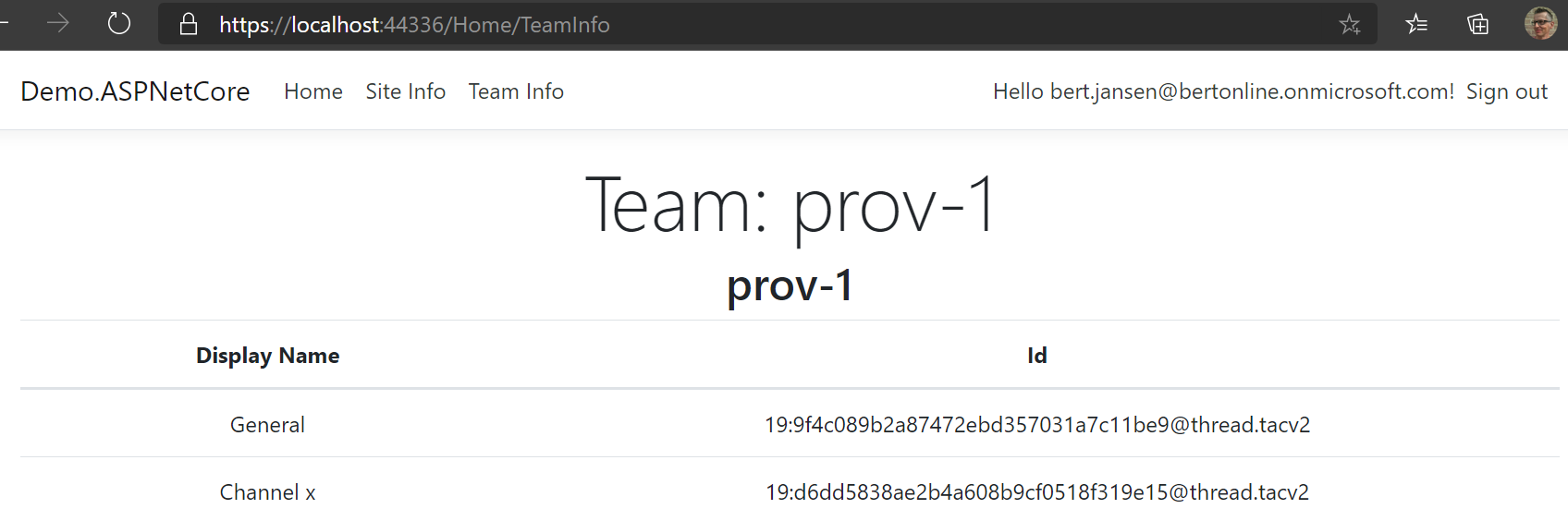
Be sure to have a Team in Microsoft Teams backing the modern team site in the above site collection
Step 3) Run the sample
Visual Studio Code and Visual Studio
Press F5 to launch the sample.
Terminal
First you will need to build the project by running dotnet build in the project folder.
Once the build is successful you can run the sample by executing dotnet run in the same folder.
Use dotnet run --environment ASPNETCORE_ENVIRONMENT={EnvironmentName} to specify the desired environment.
Default environment is Production. The default environment will be overwritten by launchSettings.json file if present. If there is no appsettings file for the specified environment, the setttings from appsettings.json will not be overwritten and will be used.
For more details about runtime environments see: ASP.NET Core runtime environments
When trying to access one of the sections, the applications prompts you for signing in.