
Copilot UX component
M365 Service Health - Live Microsoft 365 Service Health in Copilot Chat
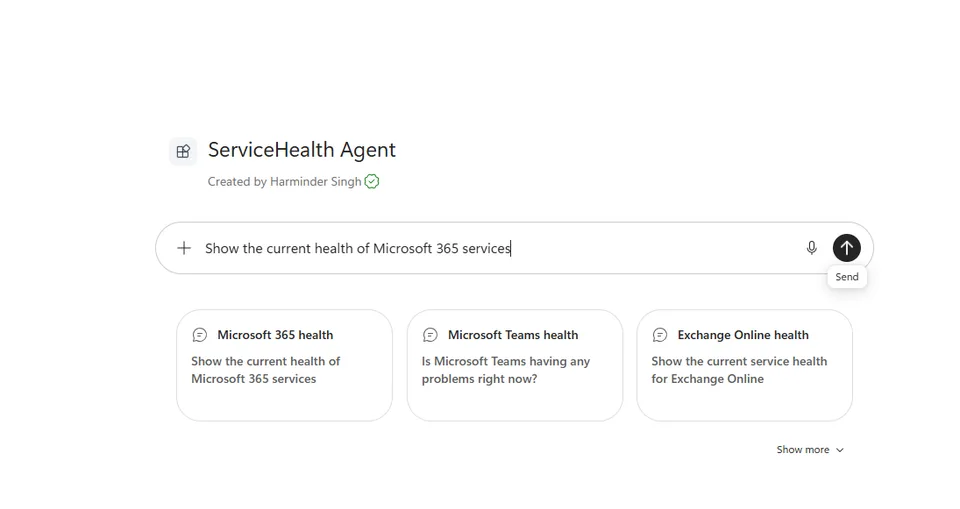
An SPFx Copilot Component that displays live Microsoft 365 service health in Copilot chat, with interactive inline and full-screen views powered by Microsoft Graph.

- Updated
- July 31, 2026
- Built with
- React
- SPFx version
- 1.24.0-beta.2
- Products
- SharePoint, Microsoft Copilot
Overview
What this sample demonstrates
M365 Service Health is a SharePoint Copilot App built as an SPFx 1.24 Copilot Component. Its declarative agent answers service availability questions by rendering live Microsoft 365 service health data from the Microsoft Graph service health API directly in the Copilot conversation.
The React component supports inline and full-screen display modes, service search, active-issue filtering, natural-language service name resolution, and issue details with impact and status updates. It also demonstrates brokered Microsoft Graph access, retry with exponential backoff, classified error handling, host-driven theming, and graceful degradation.
Gallery
See the component in action


Documentation
Setup and implementation
Summary
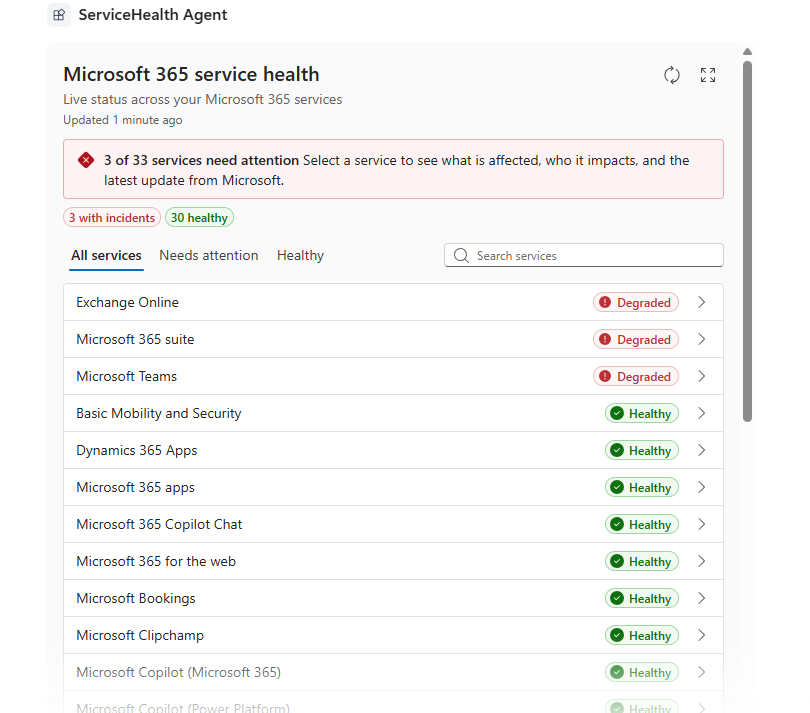
M365 Service Health is an SPFx Copilot Component that answers "is Microsoft 365 working?" without leaving the chat. A declarative agent ("M365 Service Health Agent") calls it as a tool, and it renders a live, interactive service health view inline in the conversation or as a fullscreen overview, reading real data from the Microsoft Graph service health API (/admin/serviceAnnouncement).
From the rendered UI, the signed-in user can:
- See the current status of every Microsoft 365 service, with the ones needing attention highlighted first
- Search services by name and filter to only those with active advisories or incidents
- Ask about a specific service in natural language — nicknames and abbreviations (e.g. "Teams", "SPO") are resolved automatically
- Drill into a service to read its active and recently resolved issues
- Open an issue to see who is affected and Microsoft's latest updates
- Switch between a compact inline card and a fullscreen overview


Compatibility




Applies to
- SharePoint Framework 1.24+ (Copilot Component)
- Microsoft Copilot extensibility
- Microsoft 365 tenant with the SharePoint App Catalog
Get your own free development tenant by subscribing to the Microsoft 365 developer program
Contributors
Version history
| Version | Date | Comments |
|---|---|---|
| 1.0.0.1 | 2026-07-31 | Initial release |
Prerequisites
This solution reads live service health data from Microsoft Graph, so beyond the usual SPFx tenant setup it needs the Microsoft Graph permission declared in config/package-solution.json approved by a tenant admin:
| Permission | Why it's needed |
|---|---|
ServiceHealth.Read.All |
Read Microsoft 365 service health overviews and issue details from /admin/serviceAnnouncement. |
After deploying the .sppkg to the App Catalog, a tenant admin must approve this once in the SharePoint Admin Center → Advanced → API access. Any time a requested scope changes, it needs to be re-approved there before it takes effect.
Minimal path to awesome
- Clone this repository
- From your command line, change your current directory to this solution's root
- In the command line run:
npm installnpm run start
- Since SPFx Copilot Components can't be tested in the local workbench,
npm startserves against a hosted tenant workbench - Package and deploy the solution to your App Catalog, approve the API permission above, then invoke the M365 Service Health Agent in Microsoft Copilot
Production build, test, and package:
npm run build
Other build commands can be listed using heft --help.
Features
M365 Service Health demonstrates how to surface live tenant service health inside the Copilot canvas using an SPFx Copilot Component, reading real data rather than mock content.
This sample illustrates the following concepts:
- Copilot Component UX — a
CopilotComponent(copilotType: "Ux") exposed as a tool (M365ServiceHealthCopilotTool) that a declarative agent can call, rendering its own React UI inside the Copilot host. - Zod-based tool properties schema — tool arguments (
mode,serviceName) are defined with Zod, validated withsuperRefine, and exported as JSON Schema viazod-to-json-schemafor the Copilot host. - Display-mode-aware rendering — a single React component renders a compact inline card or a fullscreen overview based on the host-advertised display mode, and can request a mode switch through the Copilot bridge.
- Brokered SSO to Microsoft Graph — service health overviews and issues are read through the SPFx-brokered
MSGraphClientV3client, with no manual token handling. - Resilient Graph access — automatic retry with exponential backoff on throttling and transient failures (429/5xx), with errors classified (unauthenticated, forbidden, throttled, network) so the UI can respond appropriately.
- Natural-language service resolution — user wording like "Teams" or "SPO" is mapped to the matching Microsoft 365 service automatically.
- Theme awareness — light/dark theme driven by the Copilot host context, using Fluent UI v9 theme tokens throughout.
- Graceful degradation — if the React tree fails to render, a plain-markup fallback still communicates the requested service and the error.
Help
If you encounter any issues using this solution, please open an issue in this repository.
Disclaimer
THIS CODE IS PROVIDED AS IS WITHOUT WARRANTY OF ANY KIND, EITHER EXPRESS OR IMPLIED, INCLUDING ANY IMPLIED WARRANTIES OF FITNESS FOR A PARTICULAR PURPOSE, MERCHANTABILITY, OR NON-INFRINGEMENT.